Thursday, 14 November 2013

Citizen Kane

Following on from our lecture on the pathology of collecting, I watched Citizen Kane. It's about a man who begins life as an ordinary young boy, from an inconspicuous family, but soon inherits a fortune and becomes a successful, wealthy newspaper publisher.

It relates to the theme of the lecture since the protagonist - Charles Foster Kane, is an obsessive collector. The extent of his collecting habits are only made fully apparent at the very end of the film where we see his life time possessions being burned; including his cherished childhood sledge - 'Rosebud'.

The film is in essence, the biography of Charles Foster Kane, told through the perspective of someone else - the reporter - who is trying to get to the bottom of the 'Rosebud' conundrum. What strikes me as significant is the fact that, the poignant moment in Kane's life was that in which he inherited his fortune. One would assume inheriting such a great fortune would bring about assurance and happiness, but on the contrary, the fortune leads to Kane's downfall. All of the possessions Kane has collected over the years are revealed at the end, and they act as materialistic clutter, which block out the one solitary possession of worth - the sledge, 'Rosebud'. It is a symbol of nostalgia, from a time where Kane was actually happy. The fact that at the end of the film 'Rosebud' is burnt, suggests that Kane never managed to regain that feeling of happiness which is both tragic yet cathartic. It destroys the artifact which provides the truth that the priers are trying to discover, thereby keeping Kane's cherished memory pure and honest.

asimranibrahima (2010). Citizen Kane Ending [Internet]. Available from: <http://www.youtube.com/watch?v=eP0O1BKu3zk> [Accessed 14 November 2013].

Blog Task 4: Pathology of Collecting

The pathology of collecting task
This week I want you to try and read  Baudrillard’s  “ The System of Collecting” text which I have uploaded onto BB in the theory folder.  Don’t worry if you don’t quite understand all of it, give it a good go and don’t give up too easily.  As before I don’t expect perfection just a good effort.

Once you have gone through it have a look at some collecting videos on Youtube.  (type in ‘obsessive collectors’, or ‘compulsive collectors or alternatively ‘ my little pony, teapot, cat etc...collectors- and you will get endless videos)

Pick one video- which you upload to your blog and write a minimum of 200 words analysing it, using at least 2 academic quotes of your choice from the Baudrillard text.

You can also add quotes from other academic texts (you can use the texts  referenced in the lecture or from the bibliography on BB).


TLC (2013). The King of Ketchup | My Crazy Obsession [Internet]. Available from: <http://www.youtube.com/watch?v=aLZ_HDVf5DY> [Accessed 14 Novermber 2013]

'The King of Ketchup - My Crazy Obsession'

If I were to examine why Ralph Finch collects extreme amounts of Ketchup, I would only need to look to the title of the video for the answer. By referring to himself as "The King of Ketchup", Ralph appears to be exercising his desire for power.

Presumably what started off as a love for the taste of Ketchup, probably grew out of control, but for a reason. I think part of the reasoning why people collect is to gain a sense of purpose, being and recognition. Since accumulating his collection, Ralph has clearly gained this title of 'Ketchup King', which brings him this sense of worth in his life. Baudrillard describes this dependence the collector has towards his object - "we can only guess at its fundamental role in keeping the lives of the individual subject or of the collectivity on an even footing, and in supporting our very project of survival." I think what Baudrillard is trying to say is, without the object, the person feels worthless - they are nobody. The object exalts them with these 'kingly' powers and gives them a reason for 'survival'. (Baudrillard 1994: 2)

I don't think I could analyse this video without commenting on the madness that is, "he cashed in his life insurance policy to pay for new additions to his collection". Where do I begin with this? From what I understood, Baudrillard deals with this type of issue by relating it to time. He illustrates it through the object of the 'wristwatch' - "On one level, the wrist-watch keeps us informed about objective time: chronometric exactitude being, of course, a factor indissociable from material constraints, social intercourse, and death. Yet, all the while it makes us submit to the temporal tyranny, the wrist-watch, as an object, also helps us to make time our own." (Baudrillard 1994: 10) This is precisely what Ralph is doing; he has essentially exchanged his life for these rare bottles of Ketchup, and by doing so he probably feels like a part of him is finite. So long as these rare bottles of Ketchup exist, so will he, long after he has died. He is manipulating time and making it 'his own' through his object, again referring back to these suggestions of a yearning for power.

Of course, Ralph's collection is merely harmless, and like he says it brings him 'pleasure'. As problematic as that may sound, we're all victims of collecting, and we all do it as a form of pleasure. It's therapeutic and brings reassurance to a person. Even when you're life feels disordered and chaotic, collecting helps bring about a sense of order or control that you may feel is lacking. We don't know anything about Ralph's life, but if collecting Ketchup makes him happy then he should continue to do it.

Wednesday, 13 November 2013

Blog Task 3: Imperial War and National Army Museum

For this lecture, we had two guests who work at the the Army Museum come and talk to us about their work and also gave a really interesting presentation on the history of the military red coat.

Following on from this, we were set the following blog task...

Blog task - Army Museum and Imperial War Museum
Visit both the museums’ permanent collections.  Both deal with conflict but from a very different perspective. 

Your first few paragraphs should consider the differences in display and point of view.  What story is the museum trying to convey?  What, if any, vested interest does it have and how is this communicated through the gallery and display design? 

The second issue to consider is emotional response.  War is a highly sensitive subject and is difficult to transfer from the ‘battlefield’ to the museum. 

Consider the following questions?
Have either museums changed your perspective/understanding of conflict? 
If so how have they changed this? (factual information, material culture, gallery design…)
How did you react to the museum exhibits, spaces and narrative?  Which of the two did you find it easier to engage with or which of the two had a bigger emotional impact on you?  Why was this?  Again focus on the museum design, narrative and communication of this narrative through objects.

This is a pretty complex task which will take you a few days if not weeks to put together so take your time in considering the issues raised.

Display from National Army Museum
Display from Imperial War Museum

To begin with, both museums vary in their display and content. For example, the Imperial War Museum had an entire exhibition entitled 'A Family in Wartime' in which models and rooms were set up as depicted above. It had an eclectic collection of objects, photographs and paintings which were displayed to depict all sorts of aspects of the war, such as: the role of women, children, gas masks, how people lived, etc. Each had display boards with information, as well as video and audio clips. It seemed to me appropriate, since it was aimed at a younger audience and had lots of interactive aspects. Nevertheless, it was also just as interesting and inclusive for adults too.

In contrast to this, I would say the National Army Museum, was much more aimed at children, on the whole. Most, if not all were child friendly and this was evident by the display - mainly mannequins or statues with reenactments of wartime depictions; some in glass cabinets and others open which encouraged interaction. The layout of the Museum was in a way that as you moved up the building, you progressed through different events in time in chronological order - Level 1 to Level 5 progresses from as early as 1784 all the way through to present day. 

From what I saw, I would say the childish nature of the exhibitions at the National Army Museum creates a less serious image of war. In a way, I think the exhibitions seem to celebrate the heroism of soldiers and Britain, rather than focusing on the loss, tragedy and devastation. In contrast, the Imperial War Museum had age restricted exhibitions such as the Holocaust Exhibition which was very serious and fairly intense in content. 

Personally, I think I preferred the Imperial War Museum, since I felt it was more age appropriate to me, although some of the exhibitions were very heavy in content which made it less engaging. In particular I found the Holocaust Exhibition had the most emotional impact. It felt more personal to me, since I am Jewish. Having grown up in a Jewish school all my life, we were taught from a young age about the Holocaust, but there were things in this exhibition which I learnt about which I previously wasn't aware of. We were never made aware that the Nazis raped the women, in fact we were told they didn't dare touch them as they didn't want to be contaminated by the Jews. I also can't recall seeing this kind of content in any other Holocaust Exhibition I've been to; so this came as quite a shock when I read about it in the exhibition. This in a way changed my perspective on war. I think it's important to keep serious topics like the Holocaust raw and honest both in content and layout. I would say the Imperial War Museum commits to this successfully. The exhibition was dark, cold and oppressive, which added to the sense of eeriness, creating a bigger emotional impact. The display had similar aspects to what you see when you visit the museums in the concentration camp in Auschwitz; cabinets of items which belonged to the prisoners in the camps: shoes, toys, false teeth and other belongings. Sometimes written information isn't sufficient, you need to see genuine pieces of history which make it real.

Both museums dealt with modern day war in Afghanistan quite differently. The National Army Museum seemed quite aware and sensitive of its young audience. The content was factual yet their agenda seemed to be aimed at painting the British as heroic. There were lots of happy pictures of soldiers reuniting with their families, therefore portraying war as more of a celebration of community and nationalism rather than devastation. Taking an opposing point of view, the Imperial War Museum had an exhibition which looked at the facts and figures of the Afghanistan War by quantifying things with diagrams, such as how much water the soldiers drink a day and how many letters are sent. It was a lot more factual and realistic in content.

A photograph I took of a soldier being reunited with his children  - National Army Museum

Overall, I would say both museums do a wonderful job of portraying War but personally, I found the Imperial War more engaging. Nevertheless, the National Army was just as informative but maybe slightly more child friendly. 


Tuesday, 12 November 2013

Drawing Week 1: Swatch Book drawing with Chetna

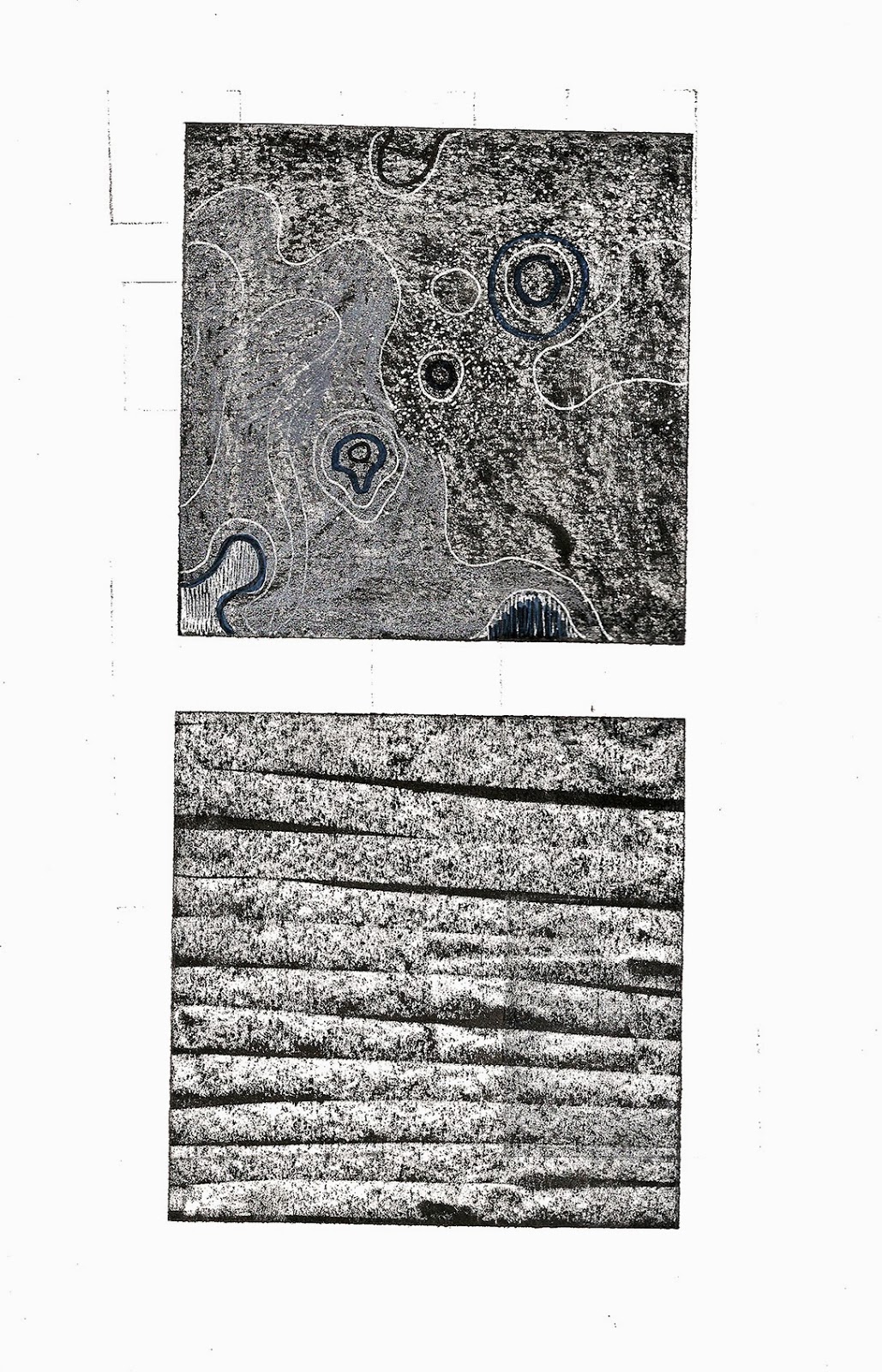
In this drawing session, we drew the textures of our objects from our box on 3 scales: small, medium and large. The smaller the scale, the more detailed the object was. Growing in scale, it became less detailed and more abstract. We focused on texture, marks, detail, silhouettes, basic shapes etc. The first few were just in black pen on white paper, then some were white medium on black paper, and the final batch were using 2 colours. The resulting drawings were all very different and intriguing in different ways which I liked. These drawings were really useful for creating compositions in print.


Drawing Week 1: Drawing objects with John Bentley

Our first session with John Bentley focused on the objects from Box Clever. We did various drawing exercises that were fun and playful, and we didn't have to worry about creating a perfect drawing. It was more about being expressive.

Drawing one object from the box in as much detail as possible in 10 minutes.

Recreating the same drawing from memory in as much detail

Drawing one object in stencil form

Drawing one object but giving it a function - my lego piece became a portable Yo Sushi!

Creating one functional object by combining 2 objects - electrical wire + feather = feather duster

Drawing Week 1: Wrappings with Lisa

We were introduced to creating wrappings, which are a really useful way of establishing a colour palette. I made a selection of 6 according to the colour scheme from my Rough Guide.

I really enjoyed making these. It was such an easy process yet the outcome is striking and effective. I particularly like the black one, since it focuses on one colour, yet the use of lots of different yarns, creates an unusual velvet like effect.


Drawing Week 1: Drawing with Kathy

To commence our first drawing week, we began by drawing our objects from our box clever collection in many different ways, as instructed by Kathy. We looked at silhouettes, outlines and line quality. The exercises also made us consider how you would apply a word to a drawing, for example, how you would reflect the word 'itchy' in a drawing - mine was quite jagged and quick in the way the marks were made.

We then created hybrid drawings using a combination of drawing techniques from the various exercises. I think these were most my successful since they were full of character and personality, and I liked the addition of colour.

As the first drawing session, I found it eased me back into drawing. It was fun, expressive and not too intense and I think the results were unique and had their own individual qualities which were successful.

This is a selection of some of the drawings...